
How to Recover When You Make a Mistake in English at Work
You’re in the middle of a sentence and you know exactly where you’re going with your train of thought, then something slips, the wrong word comes out, the right one doesn’t arrive, or you realise that what you’ve just said hasn’t come out quite as you intended. Sometimes the mistake is tiny and nobody seems to notice. Sometimes it causes a genuine misunderstanding and you have to explain yourself again, and sometimes the worst part is simply the feeling afterwards that you let yourself down.
This month, we’re looking at mistakes. Not how to avoid them completely, because none of us can do that, but what you can do when they happen and how to stop one imperfect sentence following you around for the rest of the day.
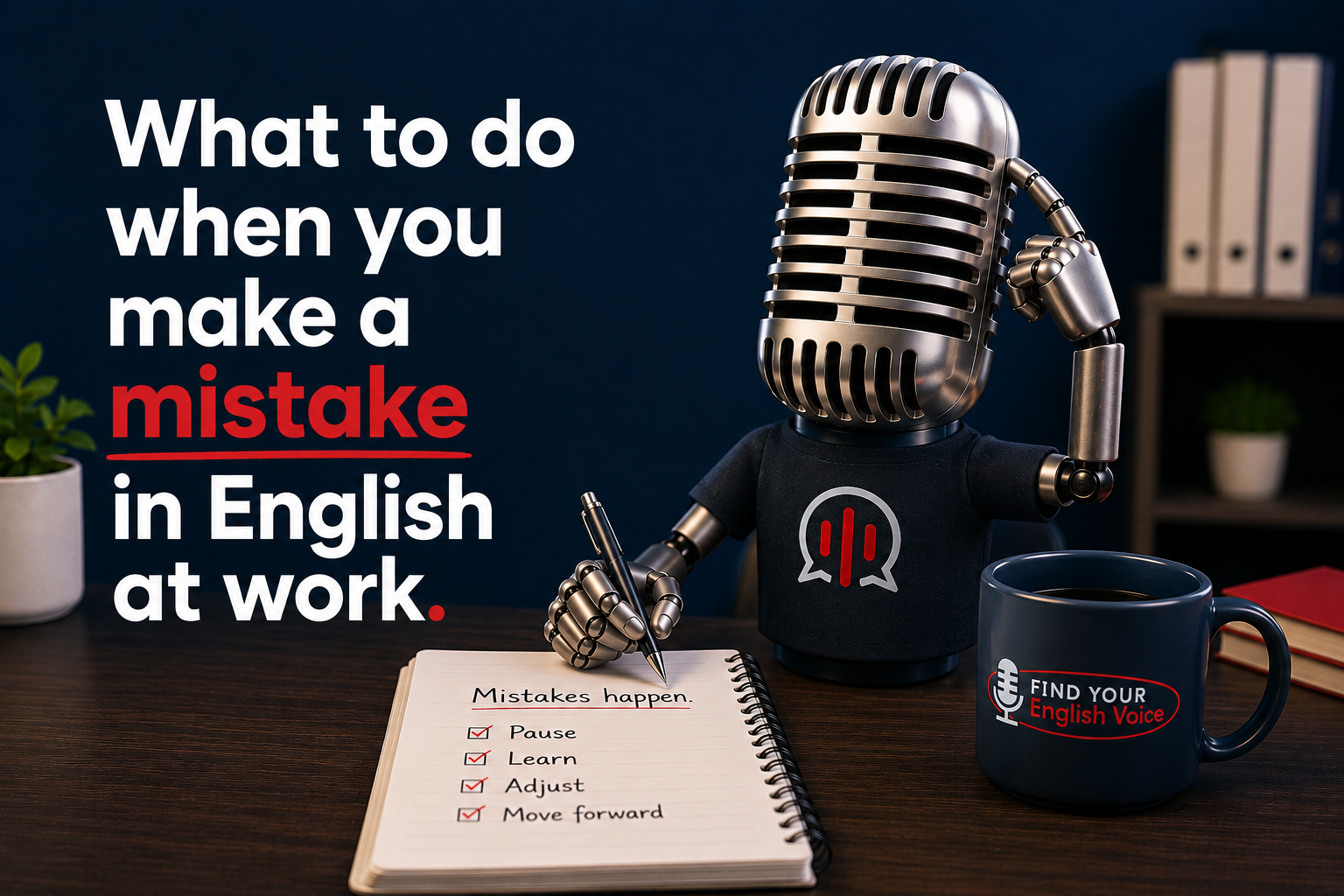
What happens after a mistake?
For many of the professionals I work with, the mistake itself is over quite quickly. It’s what happens next that causes the difficulty. You notice what you said and immediately start wondering whether everyone else noticed too. Were you understood? Did you sound unprofessional? Should you have prepared more? What if it happens again?
One of my clients is a sales manager based in Hong Kong. She uses English at work to write emails and explain quite complicated processes to clients, such as returning damaged goods or applying for refunds. She told me that phone calls worry her particularly because she can’t see the other person’s face, so it’s harder to tell whether she has been understood. I think that uncertainty is important. Sometimes it isn’t the mistake itself that stays with you. It’s not knowing what the other person thought about it. Of course, if there has been a genuine misunderstanding, you may need to correct it. But if you were understood, it’s worth asking whether the mistake really deserves all the attention you’re giving it.
Why can mistakes feel bigger in another language?
When you make a mistake in your first language, you probably correct yourself and carry on without giving it much thought. We all say the wrong word, lose our train of thought or start a sentence again from time to time. Making a mistake in a second or third language can feel different, particularly at work. You may worry that it says something about your level of English or, worse, about your professional ability.
Yola, a Purchasing Department Manager in Poland, described this very clearly:
“I often thought I wasn’t smart enough. I didn’t want to look stupid or for people to laugh at me. Those fears never helped me to speak better English; those thoughts always made matters worse.”
I’ve heard similar things from many of the professionals I’ve worked with. When you’re already worried about making a mistake, you may start monitoring every sentence as you speak. That can make it even harder to concentrate on what you actually want to say. So rather than trying to avoid every possible mistake, it can be much more useful to know how to recover when one happens.
What can you say in the moment?
If a sentence goes wrong, you don’t necessarily need to abandon it or apologise at length. Often, a simple phrase is enough to give you another go. Here are three I use with clients:
“Let me put that another way.”
This is useful when something hasn’t come out clearly and you want to explain it differently.
“What I mean is...”
This works well for a quick correction or clarification without making a big thing of the mistake.
“Sorry, let me start that again.”
Sometimes you simply need to stop and begin the sentence again. That’s fine too.
You don’t need ten different recovery phrases. Choose two or three that sound natural to you and practise saying them aloud. The aim is simply to make them familiar enough that you don’t have to search for the phrase at the same time as you’re trying to recover your original thought. Remember that you don’t always need to correct yourself. If you used the wrong tense but everyone understood exactly what you meant, carrying on may be the better option. If the mistake changed your meaning or caused confusion, correct it and continue.
What about afterwards?
For some people, this is the harder part. The meeting ends, but the conversation carries on in your head. You remember the pause, the word you couldn’t find and the sentence you wish you’d phrased differently. A client from Hong Kong, told me that he sometimes worries people will judge his level of English or his communication skills, particularly when he feels that people have expectations of him. If you recognise that tendency to replay conversations, try asking yourself two questions:
Was I understood?
Did the conversation achieve what it needed to achieve?
If the answer to both is yes, then the conversation did its job, even if your English wasn’t perfect. If there was a genuine misunderstanding, decide whether there’s anything useful you can do about it. Perhaps you need to send a quick follow-up email, clarify something with a colleague or make a note of a phrase you’d like to use differently next time. Do what needs doing, learn what you can from it and then try to leave the rest alone. Going over the same sentence twenty times isn’t going to improve it.
Recovery is something you can practise
I’d much rather help somebody become better at recovering from a mistake than spend all our time trying to make sure they never make one. Jola described a change in the way she thought about mistakes:
“Eventually, I realised that making mistakes in English would not kill me. My main goal was to understand and be understood. When I was able to stop judging myself, I became braver, and then one day there was a click.”
I like the emphasis on understanding and being understood. Accuracy matters, particularly when a mistake could change your meaning. But not every mistake has the same importance. Being able to pause, correct yourself, explain something differently and carry on is part of communicating well. Native speakers do all of those things too, without thinking about it too much. It seems quite natural as it probably does to you in your first langauge.
Something to try this month
Choose one recovery phrase and practise saying it aloud a few times. “Let me put that another way” is a good place to start. Then look for an opportunity to use it. It doesn’t have to be in a particularly difficult meeting. In fact, trying it somewhere relatively easy first will give you a chance to get used to saying it. The aim isn’t to become someone who never stumbles over a sentence. It’s to know that if you do, you have a way to continue. I’ll be talking more about mistakes and recovery throughout July, including what to do when you lose your train of thought and how to correct yourself without losing the flow of a conversation.
Take care,
Tanya
Find Your English Voice is a space for international professionals who want to feel more comfortable speaking English at work, especially when the pressure is on. Whatever brought you here, you’re very welcome.
Tanya Kaczanow is the founder of Find Your English Voice. She works with international professionals who want to use English with more calm, clarity and confidence when it matters.
Questions I hear most about making mistakes in English at work
Why does a mistake feel so much bigger in English than it would in my first language?
In your first language, you probably correct small mistakes without thinking much about them. When you’re speaking another language, particularly at work, you may pay much more attention to how you sound and what other people might think. That can make a relatively small mistake feel much more significant. Practising how to correct yourself and carry on can help make recovery feel more familiar.
I keep replaying conversations for hours afterwards. How do I stop?
Start with the two questions from the article:
Was I understood?
Did the conversation achieve what it needed to achieve?
If there’s something useful to learn, make a note of it. If you need to clarify something, do that. But if you were understood and there’s nothing you need to fix, try not to turn an imperfect sentence into evidence that the whole conversation went badly. It can also be useful to ask yourself what went well. Not because you need to force yourself to “think positively”, but because one mistake shouldn’t be allowed to become your summary of an entire meeting.
What should I do if I lose my train of thought in a meeting?
Pause. You don’t have to fill every second of silence. You can use a phrase such as “Let me put that another way” and start again. If you can’t find the exact word you want, explain the idea more simply. Your job at that moment is to communicate your meaning, not rescue the original sentence at all costs.
Is it better to acknowledge a mistake or just keep going?
It depends on the mistake. If it has changed your meaning or caused a misunderstanding, correct it. Something as simple as “Sorry, what I meant was...” is usually enough. If everybody understood you and the mistake wasn’t important, you may decide to keep going. Not every grammatical error needs its own announcement.
Why do I worry so much about phone calls?
Phone calls remove some of the visual information you get when you’re speaking face to face or on a video call. You can’t see somebody nodding or looking confused, so it may be harder to judge whether you’ve explained something clearly. Instead of trying to guess, check. You can say, “Does that make sense?”, “Shall I go over that again?” or “I just want to make sure I’ve explained that clearly.”
That isn’t apologising for your English. It’s checking that communication has worked.
Does recovering from mistakes get easier?
It can. The more experience you have of correcting yourself, explaining something differently and carrying on, the more familiar the process can become. That doesn’t mean you’ll stop making mistakes or that every difficult conversation will suddenly feel easy. The aim is much more realistic than that: a mistake happens, you deal with it, and the conversation continues.
That’s enough.
Resources
Free guide: What if speaking English at work was easier?
Get the free guide
Find Your English Voice
Find the book on Amazon
Find Your English Voice Workbook
Find the workbook on Amazon
Free discovery call
Find out about working with FYEV
Follow Find Your English Voice: Facebook | Instagram | YouTube | LinkedIn