
How to Stop Beating Yourself Up Over English Mistakes at Work
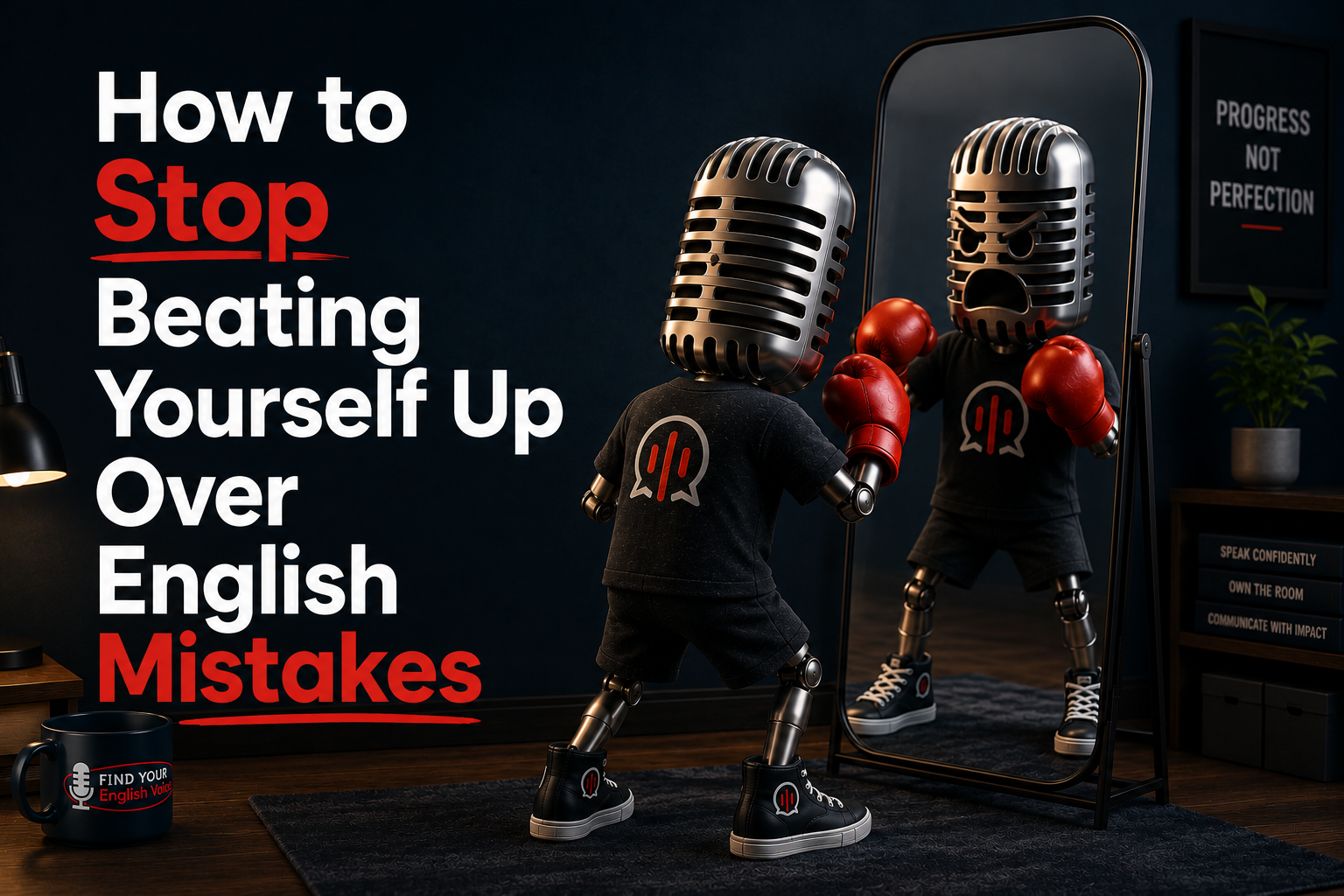
There’s a particular kind of exhaustion that comes from speaking English under pressure and then spending the rest of the day thinking about everything you wish you’d said differently. Perhaps you used the wrong word in a meeting, made a grammatical mistake or realised halfway through a sentence that it wasn’t coming out quite as you intended. The meeting finishes, everyone else gets on with their day, but you’re still thinking about that one sentence hours later. If you recognise this, the mistake itself may not be the biggest problem. It may be what happens afterwards and how much meaning you attach to it.
Mistakes are part of using a language
Making a mistake in English doesn’t mean that something is wrong with you or that your English isn’t good enough. If you’re using English in real conversations at work, you’re dealing with people, ideas, interruptions and questions you haven’t prepared for. Sometimes you’re going to get things wrong. Of course, mistakes can also show you something you need to learn. Perhaps there’s a piece of grammar you need to revisit, a word you’ve been using incorrectly or a pronunciation that causes confusion. There’s nothing wrong with noticing that and working on it. The problem comes when I made a mistake turns into My English is terrible or Everyone must think I’m incompetent. Those are very different things.
Learning any skill involves getting things wrong. I know this from my own experience as a professional singer. You practise, try something, notice what happened and make an adjustment. Nobody expects every attempt to be perfect while they’re learning a musical instrument or improving a tennis serve, yet we can have very different expectations of ourselves when we’re speaking another language at work.
Perhaps that’s because the stakes feel higher. Your colleagues are listening. You want to sound professional and you care about how you come across. That’s completely understandable, but it can also make a fairly ordinary language mistake feel much more important than it really is. One of my clients, Sylwia, who works in finance in Poland, described keeping a sort of mental scoreboard after her English meetings. She would remember the phrases that hadn’t come out quite right and spend time afterwards thinking about them. What struck me wasn’t really the mistakes themselves. It was how much energy they were taking up after the meeting was over.
When wanting to get it right stops you speaking
There’s nothing wrong with wanting to speak English well. If you use English professionally, of course you want to express yourself clearly and accurately, but if you feel that you need to have the sentence completely right before you say it, you can end up saying much less than you want to. You might sit in a meeting putting the sentence together in your head, only to find that the conversation has moved on by the time you’re ready. You might avoid using a word because you’re not completely sure about it, or spend so much time monitoring your grammar that you lose track of what you actually wanted to say.
This is where aiming for perfection can become unhelpful. Communication is happening in real time. Sometimes you need to start speaking before you’ve worked out exactly how the sentence is going to end. That doesn’t mean accuracy doesn’t matter. It does. It simply means there are times when communicating your idea matters more than producing a flawless sentence.
Try asking yourself a different question
The next time you notice yourself replaying a mistake, try looking at it a little more practically. Instead of going over how embarrassing it was or wondering what everybody thought, ask yourself what, if anything, you can learn from it. Perhaps you used the wrong tense and now you know what you’d say next time. Perhaps you discovered that you need a better way of explaining something you talk about regularly at work. Perhaps the language itself was fine, but you rushed because you felt under pressure. Or perhaps you were understood perfectly well and the mistake simply wasn’t as important as it felt at the time.
Sylwia began asking herself a very simple question after meetings: Was I understood? If the answer was yes, she tried to leave it there rather than continuing to analyse every imperfect phrase. That didn’t mean she stopped noticing things she wanted to improve. She simply became more selective about which mistakes deserved her attention. I think that’s a useful distinction. A mistake can give you information without becoming a judgement on your ability.
Something to try this month
If you tend to be hard on yourself after speaking English, start by noticing what you do after a mistake. Do you replay it? Do you imagine what other people thought? Do you immediately decide you should have prepared more or that your English isn’t good enough? When you notice yourself doing it, come back to something more useful.
Was I understood? Is there anything I want to learn from this?
If there is, make a note and come back to it later. If there isn’t, see if you can let that particular sentence go. Over the next few weeks, I’ll be talking more about making mistakes, taking small risks with your English, correcting yourself without losing your flow and finding a more realistic balance between accuracy and communication. If you’ve been giving yourself a hard time over every imperfect sentence, perhaps this is a good month to try something different. What’s one mistake you’ve made recently that you could look at as useful information rather than something to keep replaying?
Take care,
Tanya
Tanya Kaczanow is the founder of Find Your English Voice. She works with international professionals who want to speak English with more calm, clarity and confidence when the pressure is on. findyourenglishvoice.uk
Resources
Free PDF guide: findyourenglishvoice.uk/free-guide
Find Your English Voice: mybook.to/FindYourEnglishVoice
FYEV Workbook: mybook.to/FYEV-Workbook
Free discovery call: findyourenglishvoice.uk/contact
Facebook / Instagram / YouTube / LinkedIn: @findyourenglishvoice.uk
Questions I Hear Most About Beating Yourself Up Over English Mistakes
Is it normal to feel embarrassed about mistakes in a second language at work?
Yes, and it doesn't mean you're underprepared or unprofessional. The embarrassment is a sign the stakes feel high to you, not a sign that you've failed. Most people carry this feeling privately, which is exactly why it can feel so isolating, and exactly why it helps to hear that it's common rather than personal.
How do I stop replaying a mistake for the rest of the day?
Start by noticing when the replay begins, rather than trying to stop it outright. Once you catch it, ask what the mistake actually taught you, rather than what it says about you. Sylwia found it helpful to ask herself one specific question each time: was I understood? If the answer was yes, she let herself close the file on it, even if it hadn't felt elegant in the moment. That one habit did more for her than any amount of trying to think positively.
Will my colleagues think less of me if I make mistakes in English?
In most professional settings, colleagues are focused on what you're communicating, not on grading your grammar. The harshest critic in the room is almost always you, and it's worth remembering that most people are far too preoccupied with their own performance to be quietly scoring yours.
How long does it take to feel confident again after a difficult meeting?
There's no fixed timeline, and it varies from person to person and situation to situation. What speeds it up is treating the mistake as data rather than a verdict on your ability. That's exactly the shift we'll be building on this month, and it's the same shift that eventually let Sylwia put her mental scoreboard down for good.
Resources
Free guide: What if speaking English at work was easier?
Get the free guide
Find Your English Voice
Find the book on Amazon
Find Your English Voice Workbook
Find the workbook on Amazon
Free discovery call
Find out about working with FYEV
Follow Find Your English Voice: Facebook | Instagram | YouTube | LinkedIn