
Why Do I Freeze When Speaking English at Work? How to Stay Calm Under Pressure
Your heart races. Your jaw tightens. You reach for the words you know are there. And they are gone. If you have ever experienced this, you will recognise it immediately. That moment when your body seems to work against you at exactly the wrong time. When everything you have prepared, everything you know, feels suddenly unavailable.
Most people assume something is wrong with their English. So, they study harder, prepare more thoroughly, and hope that next time will be different.
But the problem is not your English.
What is actually happening
When you are put on the spot in a meeting or asked to present in English, your brain registers threat. Not physical danger. But your nervous system cannot always tell the difference between those things and a boardroom.
So, it does what it is designed to do. It activates your sympathetic nervous system, what most people know as the fight-or-flight response. Cortisol and adrenaline flood your system. Your heart rate rises. And your prefrontal cortex, the part of your brain responsible for language, reasoning, and clear thinking, partially goes offline. Most advice focuses on thinking differently. But you cannot think your way out of a body response. You cannot think your way calm.
The English is there. Under pressure, your brain simply cannot reach it. The problem is access, not ability.
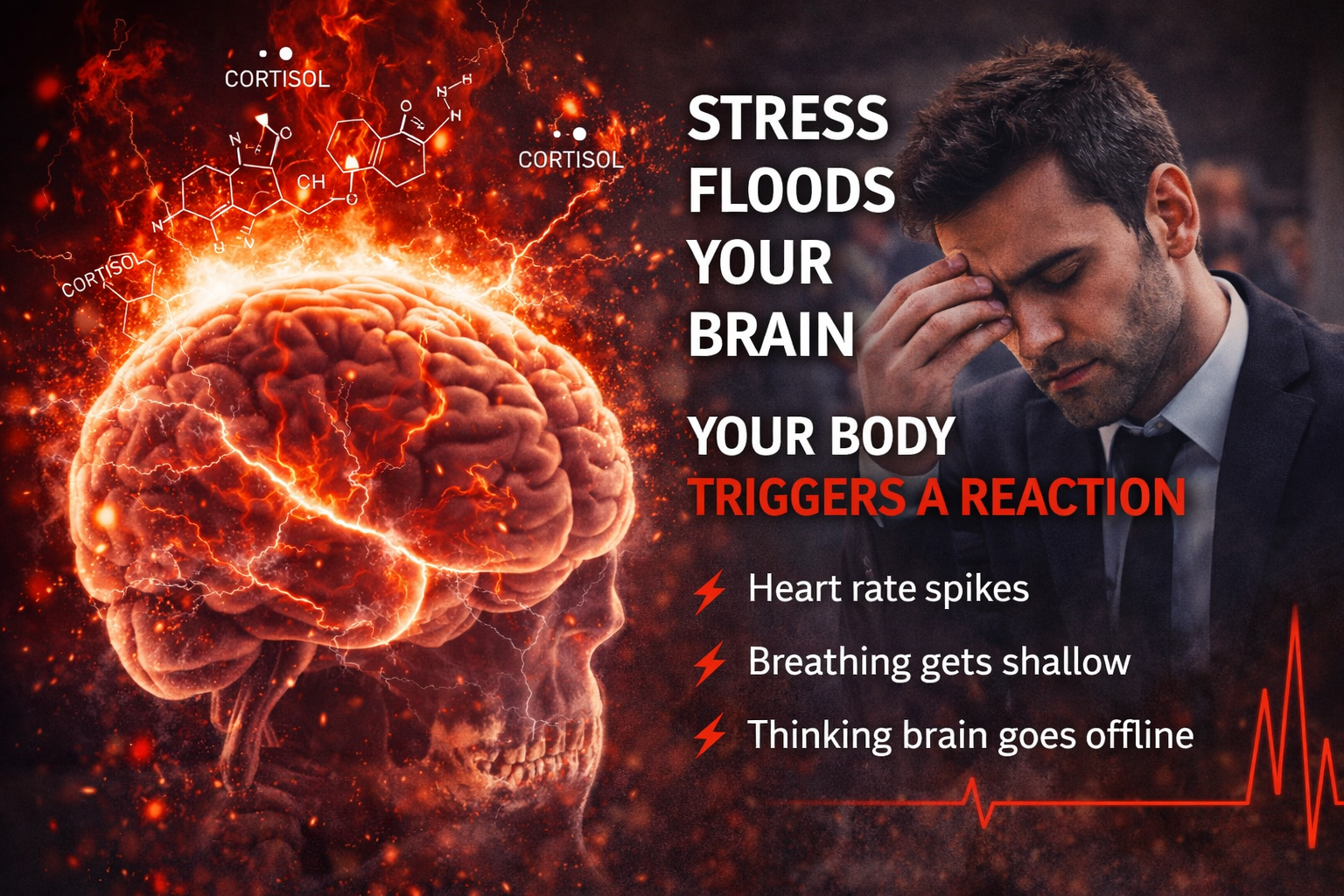
Stress floods your brain
It is also worth saying this clearly: if you are navigating all of this in a second or third language, you are managing something genuinely harder than most of the people around you. The cognitive load is real. The fact that your English sometimes falters under pressure is not a reflection of your ability. It is a reflection of that load.
One of my clients, a senior manager in Poland, described it perfectly: “When I feel judged, I suddenly can’t access the words I know.” Her English didn’t disappear. Her nervous system took over.
The good news
Nervous system responses can be trained. With the right tools practised consistently, you can change how your body responds to pressure and you can use these tools in the moment, when you need them most. These are not emergency tools. They are skills you train when things are calm, so they work when they’re not. Action cures all.
Here are the three I come back to most with the professionals I work with.
The physiological sigh
This is the fastest tool I know for shifting your physiological state in real time. It was studied by Andrew Huberman and his team at Stanford University, and the research shows it can calm your nervous system in seconds.
Take one breath in through your nose. Then, without exhaling, take a second shorter breath in through your nose to fully inflate your lungs. Then breathe out slowly and completely through your mouth. The exhale should be significantly longer than both inhales combined.
That long, complete exhale is what does the work. It activates the vagus nerve, which signals to your body that the threat has passed. Your heart rate begins to slow almost immediately. One or two cycles before a difficult speaking moment is enough to notice a shift.
Jaw release
When you are tense, your jaw tightens, often without you noticing. A tight jaw changes your voice. It makes it smaller, flatter, harder to project. The words are there. They just cannot get out the way you want them to.
Before you speak, drop your jaw deliberately. Let it hang loose for a few seconds. The physical release creates a vocal release almost immediately. Your voice sounds more like you. I learned this as a professional singer long before I became a coach. The connection between physical tension and vocal quality is direct and consistent.
Grounding
When your mind is racing before you speak, grounding is the fastest way back to the present moment. Feel your feet on the floor. Press them down deliberately. Notice the weight of your body in your chair. Take one breath.
This works because physical sensation competes with anxious thought for your attention, and wins. You cannot be fully present in your body and fully lost in your thoughts at the same time. Grounding does not eliminate anxiety. It interrupts the spiral long enough for you to begin speaking. And once you have started, the rest tends to follow more naturally than you expected.
One more thing worth knowing
Research from Harvard Business School by Alison Wood Brooks found that people who reframed their nerves as excitement, by saying "I am excited" out loud, performed better at public speaking than those who tried to calm down.
The reason is physiological. Anxiety and excitement feel almost identical in the body: raised heart rate, heightened alertness, a surge of energy. Shifting from anxious to excited requires only a small cognitive change. Shifting from anxious to calm is a much larger jump and much harder to make in the moment.
So instead of telling yourself to calm down, try saying out loud: "I am excited." It may feel strange the first time. The research suggests it works regardless.
This month
April is about building your toolkit for staying calm under pressure. Not through willpower, but through understanding how your body works and giving it what it actually needs.
This week, try the physiological sigh. Just once. Before a meeting, a phone call in English, or any moment you know will feel difficult. Two inhales through your nose. One long, complete exhale through your mouth.
The words are there. This month is about making sure you can reach them when it matters most. I have put together a free PDF this month, You don’t have an English problem, you have a pressure problem, which has all three tools in one place. Link below. These tools are not just for high-pressure moments.Practise them daily, so your body knows what to do when it matters.
Find Your English Voice is a space for international professionals who want to speak English with more confidence and less anxiety. Whatever brought you here, you are welcome.
Take care of yourself this month. I will see you in May. Bye for now…
Tanya
These are the questions I hear most from the professionals I work with, on the topic of speaking English under pressure. If yours is not here, feel free to ask it in the comments.
Questions I hear most about speaking English under pressure
Why does my English get worse when I am nervous? I know the words but they just disappear.
This is one of the most common things I hear, and it has a straightforward explanation. When your brain registers pressure, it activates your fight-or-flight response. Part of what happens in that process is that your prefrontal cortex, the part responsible for language, reasoning and clear thinking, partially goes offline. The words have not gone anywhere. Your brain simply cannot reach them in that moment. This is why more vocabulary or more preparation does not solve it. The problem is not what you know. It is access to what you know under pressure.
I prepare really thoroughly before meetings and presentations, but it still goes wrong in the moment. Why?
Preparation helps with content. It does not help with your nervous system. When the pressure rises in the room, your body responds to the threat it perceives, regardless of how well you have prepared. The tools that actually help in the moment, the physiological sigh, grounding, jaw release, work at the level of your body rather than your mind. That is why they work when preparation alone does not.
Is this just a confidence problem? Everyone tells me I just need more confidence.
It is not a confidence problem, and "just be more confident" is genuinely unhelpful advice for most people. What you are experiencing is a nervous system response to pressure. Confidence tends to come after repeated experience of handling those moments, not before. The tools in this post give you a way to begin handling the moments, which is where confidence actually comes from.
I speak English well in casual conversations. Why is it so much harder in formal situations?
The difference is stakes. In a casual conversation, the perceived risk is low and your nervous system stays relatively calm. In a formal situation, your brain registers evaluation, judgment, or visibility, and the fight-or-flight response kicks in. The English is the same. The physiological state is completely different. That is why the same person can be fluent over coffee and struggle in a boardroom. It is not inconsistency. It is biology.
Does this get easier? Or will I always feel like this under pressure?
It genuinely gets easier, but not by itself. The nervous system learns through repeated experience. Each time you use a tool like the physiological sigh consistently, each time you speak in a pressured moment and survive it, your brain updates its threat assessment. Over time, situations that once triggered a strong response begin to feel more manageable. This is not about eliminating nerves entirely. It is about changing your relationship with them so they stop getting in the way.
I have tried breathing exercises before and they did not work for me. Why should the physiological sigh be any different?
Most breathing exercises ask you to slow down and breathe deeply, which can actually increase anxiety in some people because it draws attention to the breath itself. The physiological sigh works differently. The double inhale followed by a long complete exhale directly activates the vagus nerve and triggers a parasympathetic response. It is not a relaxation exercise. It is a physiological mechanism. If you have not tried it specifically, it is worth giving it a proper attempt before ruling it out.
Have a question about speaking English at work? I may have already answered it here.
https://www.findyourenglishvoice.uk/faq
Resources: Free PDF, link below.
You don’t have an English problem, you have a pressure problem: www.findyourenglishvoice.uk/free-guide
Find Your English Voice https://mybook.to/FindYourEnglishVoice
FYEV Workbook: https://mybook.to/FYEV-Workbook
Free discovery call: https://www.findyourenglishvoice.uk/
Contact Facebook / Instagram / YouTube / LinkedIn: @findyourenglishvoice
Find Your English Voice. findyourenglishvoice.uk