
Why do I hesitate before speaking English at work?

You’re sitting in a meeting when you think of something useful to say. You understand the discussion and you know the point you want to make, but you hesitate.Perhaps you begin wondering whether your idea is relevant or whether you can express it clearly enough in English. You wait for a better moment, somebody else starts talking and the conversation moves on.It may only take a few seconds, but it happens often enough that you start to notice a pattern. You leave meetings thinking about the things you could have said and wondering why you didn’t say them.Last month, I wrote about what I call your fear fingerprint: the particular people, situations or types of conversation that make speaking English feel more difficult. Recognising the pattern is useful, but it doesn’t necessarily help you act differently while the moment is happening.This month, I want to look at that brief space between thinking of something and deciding whether to say it. I call it the hesitation window.
What happens in the hesitation window?
The hesitation window is the point at which a useful thought can quickly become a doubtful one.At first, your idea may seem clear. Then the questions begin. Is this worth saying? Is now the right time? What if my grammar is wrong? What if I can’t finish the sentence?The longer this discussion continues in your head, the harder it becomes to join the real conversation. You’re no longer simply thinking about the subject of the meeting. You’re also monitoring your language, judging your idea and trying to predict how other people will react.By the time you’ve considered all of that, the opportunity may have gone.This doesn’t necessarily mean that you didn’t know what to say. In many cases, you knew perfectly well what you wanted to contribute. The difficulty was beginning before you had time to talk yourself out of it.
Lukasz’s experience
Lukasz is a principal software engineer in Poland and somebody I’ve worked with for more than a decade. His English is strong. He reads technical documentation, communicates with international colleagues, supports customers and learns through English-language resources as part of his everyday work.Earlier in his career, however, he sometimes avoided meetings where he knew he would be the only non-native English speaker. When we once had the opportunity to meet in person, he told me afterwards that he had been nervous about having dinner with me. The thought of speaking English one-to-one for an entire evening had felt overwhelming.This was somebody who was already using English successfully in his job. The difficulty wasn’t a lack of knowledge. He felt exposed in situations where he couldn’t prepare, step back or allow somebody else to do the talking.
When I asked him about it recently, he said, “I no longer skip meetings in which I am the only non-native, like I used to.”That sentence says a great deal about how far he has come. He didn’t wait until his English felt perfect before attending those meetings. He gradually became more comfortable by putting himself in situations where he had to use it.He now attends online public meetings each week, partly because they give him the opportunity to explain things and ask questions naturally. He deliberately doesn’t prepare exactly what he is going to say because responding in the moment is what he wants to practise.That kind of practice can feel uncomfortable, but it is closely connected to the skill he wants to develop. He isn’t learning a speech. He is becoming more accustomed to speaking without one.
A simple way to interrupt the waiting
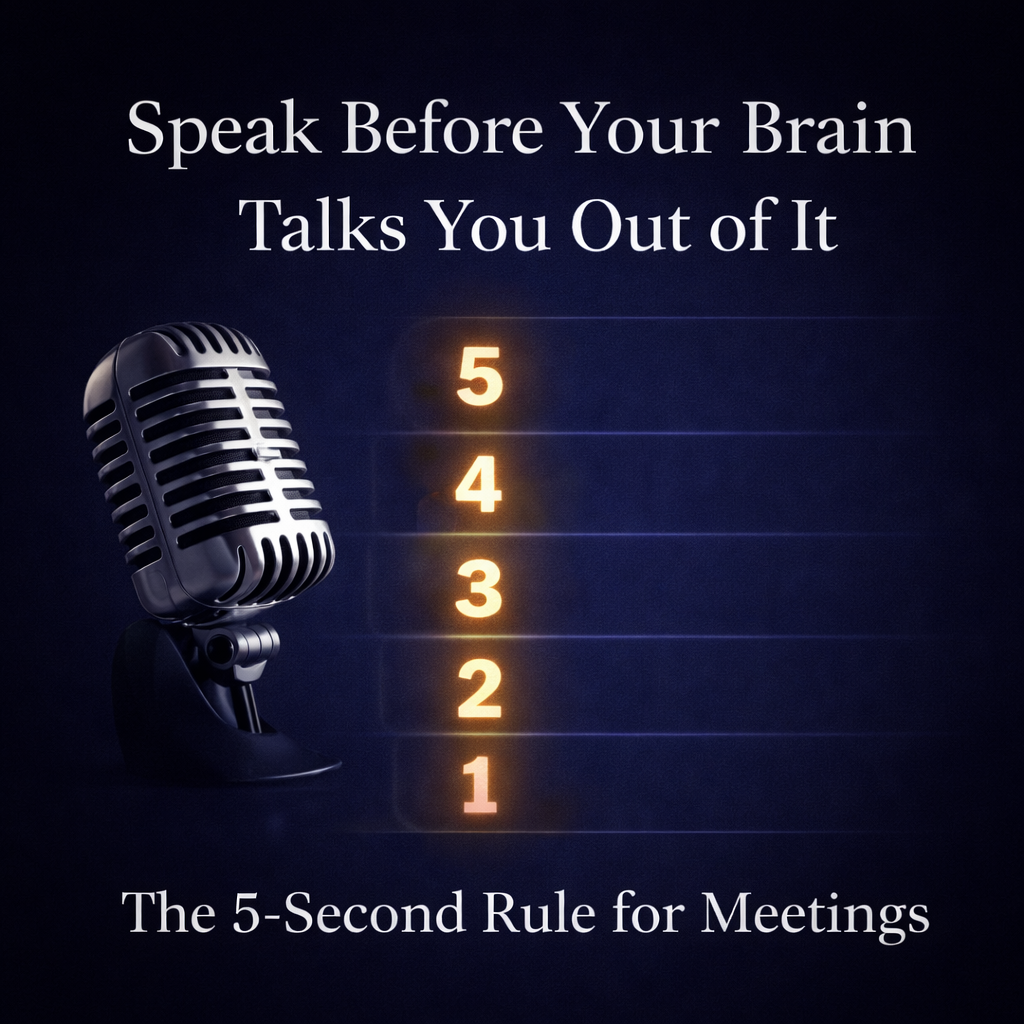
One technique you could try is a short countdown. When you notice that you have something to say, count backwards from five and begin before you reach zero.This idea is often associated with Mel Robbins and her five-second rule. I don’t think we need to make complicated scientific claims about why it works. Its value is much simpler: it gives you a clear point at which to stop debating with yourself and take action.In a fast-moving meeting, five seconds may be too long. You might count three, two, one, or simply decide that once you notice the impulse to speak, you will begin as soon as there is an opening.
A countdown won’t remove every anxious thought and it won’t guarantee that your sentence comes out exactly as you intended. What it can do is shorten the time available for overthinking.Try it first in a situation where the pressure is fairly low. You could use it to ask a question in a familiar meeting or contribute a brief comment during an informal conversation. The purpose is to practise acting on the decision to speak, not to force yourself into the most difficult situation you can imagine.
You don’t need the whole sentence before you begin
One reason people hesitate is that they feel they should know exactly how the sentence will end before they say the first word.Real conversation rarely works like that. We begin speaking, adjust what we’re saying and sometimes pause while we decide how to continue. We clarify, rephrase and occasionally abandon one sentence to start another. Native speakers do this too.Having a few comfortable opening phrases can make beginning easier. You might use something such as “I’d like to add something here,” “Can I come in on that?” or “I think there’s another point to consider.”The best phrase is one that sounds natural when you say it.
You don’t need a list of ten expressions to memorise. One or two that you have used aloud several times will be much easier to reach when you need them.These phrases don’t give you a complete script. They simply help you put your voice into the conversation while the rest of your thought catches up.If you lose your way after you begin, that doesn’t mean the attempt has failed. You can pause, rephrase or say, “Let me put that another way.” Most people are far less concerned about these adjustments than we imagine.
Confidence tends to follow experience
It is easy to believe that you will speak more when you feel confident enough. The problem is that confidence often develops because you have spoken, not because you waited.Each time you contribute while feeling slightly unsure, you have another experience to draw on. The sentence may not be perfect and you may still feel nervous, but you took part in the conversation and managed whatever happened next.Gradually, speaking begins to feel less unusual. The first word doesn’t carry quite so much weight because you have more evidence that you can begin without knowing exactly how everything will come out.This doesn’t happen in a perfectly straight line. You may speak comfortably in one meeting and hesitate again in the next. That is normal. The aim isn’t to remove every pause or become somebody who speaks without thinking. It is to recognise when useful thinking has turned into the kind of overthinking that keeps you silent.
What to try this week
Before your next meeting, choose one or two phrases that you could use to enter the conversation. Say them aloud a few times so that they feel familiar rather than like something taken from a business English textbook.During the meeting, notice the moment when you have something to add. If you usually begin questioning yourself, try counting backwards and speak when you reach zero. You don’t need to contribute a long or complicated point. A question, a clarification or a brief comment is enough.Afterwards, resist the temptation to analyse every word you used. Ask yourself whether you began. If you did, that is the part worth noticing.The next time you have an idea in a meeting, you may still feel that familiar hesitation. You don’t have to wait for it to disappear. Give yourself a few seconds, use a phrase that feels natural and begin.Bye for now...TanyaIf you have a question about speaking English at work, you’re welcome to contact me at tanya@findyourenglishvoice.uk.
Questions I often hear about hesitation in meetings
Why do I hesitate when I already know what I want to say?
Knowing what you want to say is only one part of joining a conversation. You also have to decide when to speak, choose how to begin and accept that the sentence may not come out perfectly. If you spend too long checking all of this in your head, the moment can pass before you’ve said anything.
Can counting backwards really help me speak?
A countdown is simply a practical way to give yourself a point at which you will act. It won’t make the nerves disappear or provide the words for you, but it may stop a short pause from turning into a long internal debate. Try it in a relaxed situation first and see whether it helps you.
What if I begin speaking and then lose my train of thought?
Pause and give yourself a moment. You can say, “Let me put that another way,” or “What I’m trying to say is...” Losing your train of thought occasionally is a normal part of speaking, particularly when you’re under pressure. You don’t need to apologise repeatedly or abandon your point.
How can I find a natural way to join a meeting?
Listen to the phrases that you and your colleagues already use. Choose one or two that suit the way you normally speak and practise saying them aloud. A familiar opening makes it easier to begin without planning the whole contribution in advance.
Will I ever stop hesitating completely?
You may always pause occasionally, particularly in unfamiliar or important situations. What can change is how long the hesitation lasts and what you do next. A brief moment of uncertainty doesn’t have to become a reason to remain silent.
5. 4. 3. 2. 1.
Resources:
Find Your English Voice (Book): [Link]
Find Your English Voice Workbook: [Link]
Free 20-minute discovery call: [Link]
Follow for more:
Facebook: https://www.facebook.com/findyourenglishvoice
Instagram: https://www.instagram.com/findyourenglishvoice.uk
Youtube: https://www.youtube.com/@findyourenglishvoice
Linked in: www.linkedin.com/in/findyourenglishvoice
Amazon author page: https://www.amazon.com/author/tanya-kaczanow